
Overview
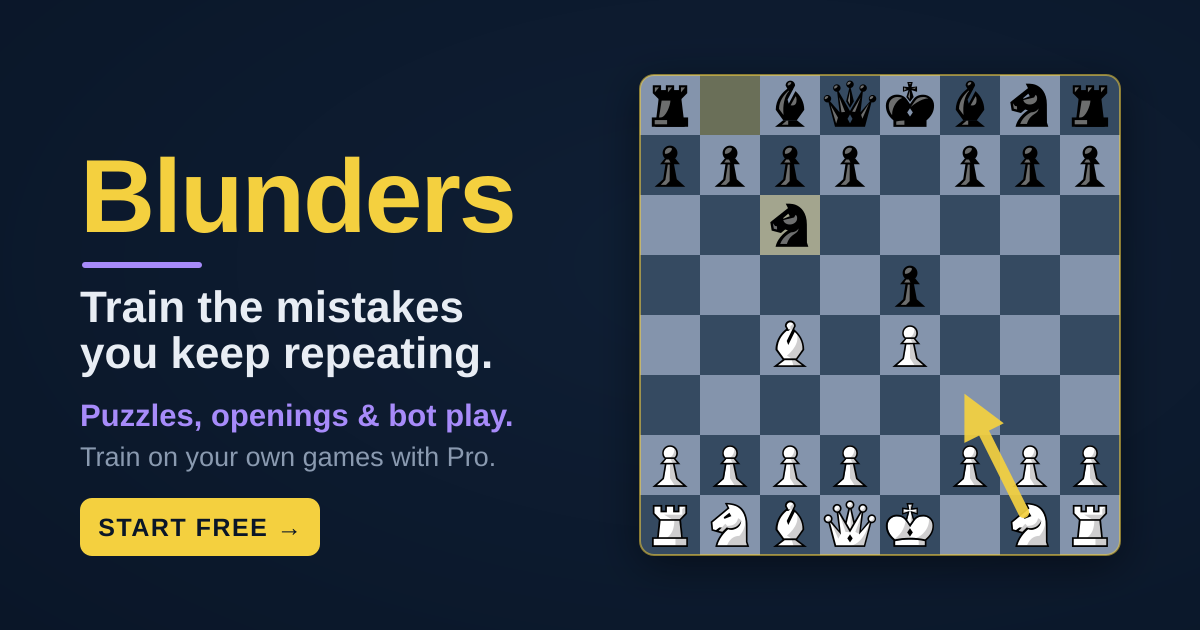
Blunders.ai pulls your actual games from online chess platforms and turns your real mistakes into targeted training material. Instead of working through generic puzzle sets, you drill the exact positions where your own games fell apart — openings you misplay, endgames you blunder, tactical patterns you consistently miss. The AI coach analyzes your game history to identify recurring weaknesses and serves up puzzles calibrated to your current level and problem areas. You're not grinding through someone else's curriculum; you're fixing the specific holes in your own game. It's freemium, so you can connect your account and get a baseline read on your weaknesses without paying. The depth of coaching and puzzle volume presumably scales with a paid tier.
- Generate puzzles directly from your own game blunders and missed tactics
- Get AI coaching feedback tied to your personal game patterns, not generic advice
- Identify recurring weaknesses across your game history automatically
- Train on positions that match your actual playing style and rating range
- Connect existing online chess accounts to import game history
What stands out
- Training is grounded in your real games, which makes mistakes harder to ignore and easier to remember
- Cuts through the noise of generic puzzle books by targeting your actual weak spots
- Freemium entry point lets you evaluate usefulness before committing money
- Scales with how much you play — more games means more personalized data
Where it falls short
- Usefulness depends heavily on having an existing game history; new players with few games get less signal
- AI coaching quality is hard to evaluate without knowing the underlying model or how it handles complex positional errors
- Freemium limits are unspecified upfront, so it's unclear how much value you get before hitting a paywall
Who it's for
- Club and online players stuck at a rating plateau who want to know exactly why they keep losing
- Beginners who learn better from their own mistakes than from abstract exercises
- Competitive players who want structured post-game analysis without hiring a human coach
- Chess students who play regularly on Lichess or Chess.com and want their game history to do more work
Pricing
What we hold on record for Blunders.ai.
- Pricing model
- Freemium
Advertised prices often assume annual billing — The Annual-Billing Illusion , our study of 150 tools.
Our take
Anki for your chess blunders
— Toolhunter editors
Frequently asked questions
Is Blunders.ai free?
There's a free tier. Paid upgrades are available.
What is Blunders.ai used for?
Anki for your chess blunders. It's listed under Assistant in our directory.
What are the best Blunders.ai alternatives?
The closest matches in our directory are Honer AI, VibeCodingList, Disk Prices Tools and ReadyHermes — see "More tools like this" below for the full set.
Keep comparing
Reviews
No reviews yet
Be the first to share your experience.
More tools like this
All Assistant tools →Looking for AI tools similar to Blunders.ai? These are the closest picks in our index.

Android AI assistant with chat, web search, photo and document analysis, and voice input.

VibeCodingList is the builder network and feedback marketplace for AI-built and vibe-coded products. Builders submit live apps, games, tools, SaaS projects, and experiments, then ask one clear question so contributors know what to check. Other builders and product-minded contribu

Disk Prices Tools is a free storage comparison platform that brings every HDD, SSD, and NVMe drive into one sortable table with automatic $/TB, full specs, advanced filters, live search, and community-powered corrections. No sign-up needed.

Your own hosted Hermes Agent in a minute: memory, self-learning skills, schedules, a real browser and 1,000+ app connections.

Blur faces, text & license plates instantly in your browser. 100% private AI — no uploads, no sign-up.

Turn long videos into captioned shorts with AI-powered clip selection, editing, and vertical framing.

Create, remix, and edit cinematic AI videos online with Free Gemini Omni using text, image, audio, and video prompts.

Competitor watching, automated.

One frame. One guess. One movie.